


The Basic Principles of Air Springs
There are two basic types of air springs used in vehicle suspensions: reversible sleeve air springs and corrugated air springs. Whether the air spring is a reversible sleeve type or a toroidal air spring, its working principle is the same; when a certain volume of gas in the container is compressed, a reaction force is generated... For an air spring, the gas is air and the container is Sealed fabric reinforced rubber bellows or sleeve. Similar to an inflated ball, the load an air spring experiences depends on its diameter and therefore the area of the air column and the pressure inside the air.
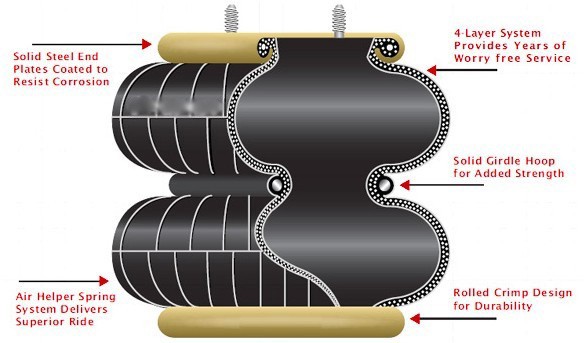
The two basic relationships used to determine the load carrying capacity of an air spring are:
(1) It can be seen from the above relationship that increasing the load that an air spring can carry can be achieved by increasing the pressure inside the air spring, increasing the diameter of the air spring (thereby increasing the area), or both.
Changing the load capacity simply by changing the air pressure rather than replacing the air spring is a major advantage of air springs over steel springs. Since air springs are composed of a closed volume of air, compression of the air spring (bounce stroke) will cause the pressure to increase, while extension of the air spring (rebound stroke) will cause the pressure to drop. This allows the air spring to automatically return to its set neutral or design height when disturbed by the driving surface.
The dynamic build-up of compression also helps prevent "bottoming out," and the compression force of a reversible sleeve air spring can be further increased by adding a "flare" at the bottom of the piston.