


Purpose of Groove-and-Protrusion Locating Feature
Vehicle OEMs enforce strict angular-position requirements for struts during vehicle assembly. To achieve precise alignment between strut and vehicle body and streamline assembly-line work, OEMs require consistent angular orientation for every manufactured strut.
Strut manufacturers adopt locating processes to satisfy OEM requirements via two different solutions:
Angular positioning is completed during the crimping operation of piston and end fitting;
Angular positioning is implemented when assembling the air-spring onto the damper core cartridge.
This creates two product variants: some units have locating geometry (matching groove and protrusion) between piston and end fitting, while others remove these locating features.
Is Removing the Locating Groove a Valid Quality Optimization?
The paired locating groove and protrusion raise complexity for component machining and assembly, making production more cumbersome.
If angular positioning can be guaranteed through alternative manufacturing steps, removing the piston-side locating groove and protrusion counts as reasonable quality optimization and introduces zero product-quality risks.
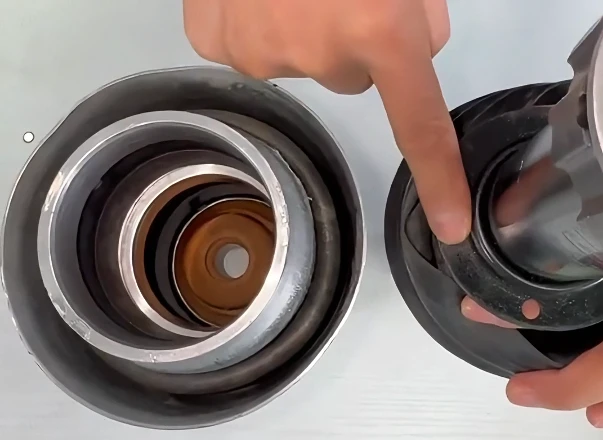
💡Note: The critical factor is not whether the piston locating groove exists. What truly matters is that reliable angular positioning is achieved elsewhere in production. Removing this local feature is perfectly acceptable as long as overall orientation control remains intact.
Question for you: Would you keep or eliminate the piston locating groove in your real-world development and production projects?
Tags: #DamperStrut #AirSpring #PistonLocatingGroove #AirSuspensionManufacturing #AutoPartsR&D
Click the link below to watch our explanatory video:https://youtube.com/shorts/doKBN2Ilpa0?si=ET6YoXP9GIu-iFfY